Type "best time to visit Kyoto" into classic Google, and it processes that one query, once. Type the exact same thing into Google's AI Mode, and behind the scenes, that single query has probably already turned into five, eight, maybe a dozen separate queries, all running at the same time, before you ever see an answer.
That's called query fan-out, and honestly, once I understood what it actually meant, it changed how I brief content for the businesses I work with. If you're only optimizing for the exact query someone typed, you're optimizing for a small slice of what the system actually went and searched for on your behalf.
What's Actually Happening
Fan-out means the system takes one query and breaks it into multiple sub-queries, exploring different angles of the same question at once instead of treating it as one flat request. It's the mechanic behind Retrieval-Augmented Generation and a lot of what powers AI-driven search generally, not some feature specific to one product.
Roughly, it goes through a handful of distinct steps:
1. Understand the query. The system first figures out what you're actually asking and how complex it is. 2. Generate sub-queries. It produces a batch of related searches covering different facets of the original question. 3. Search in parallel. Each sub-query runs against the live web, the Knowledge Graph, and wherever else is relevant, all at roughly the same time. 4. Filter for trust. Results get evaluated for credibility before anything gets used, similar in spirit to the E-E-A-T signals I've written about elsewhere. 5. Synthesize the answer. One final answer gets written, stitched together from whichever passages, across the whole search, performed best.
Not every query gets this treatment. Something simple like "capital of France" doesn't need to be split apart, there's nothing to explore. Something like "best private tour Rome with family" has enough real facets, cost, duration, whether kids will be bored, accessibility, that fan-out genuinely helps answer it properly.
Where I've Actually Seen This Play Out
Take "best things to do in Kyoto." A fan-out system is very likely generating separate searches for temples, neighborhoods, sample itineraries, food, transportation, guided tours, and the less obvious spots, all at once.
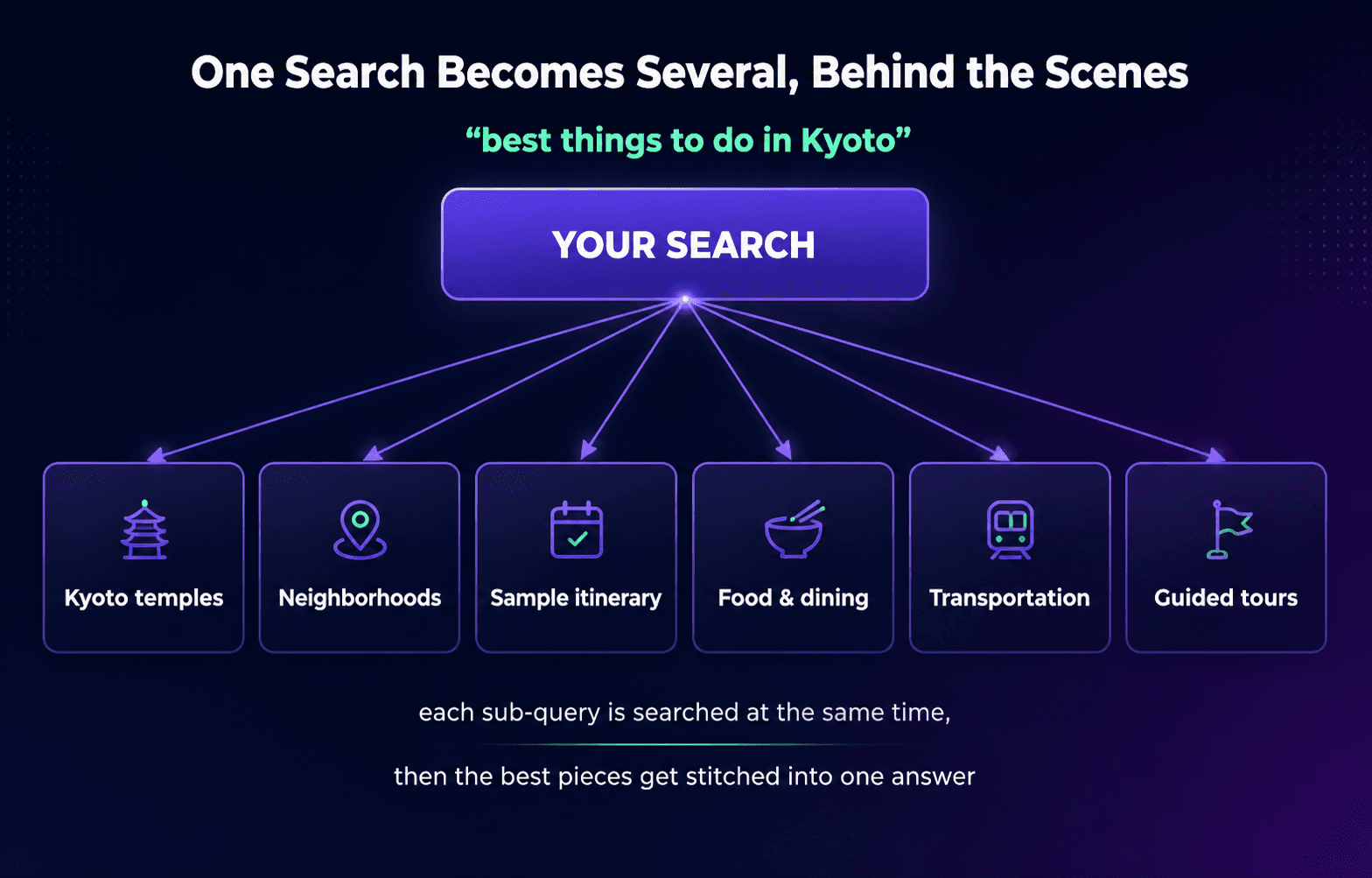
That's roughly what's happening behind the scenes, one question quietly becomes six, searched in parallel, before you ever see a single answer stitched together. Each of those retrieves its own set of candidates, and the final answer gets stitched together from whichever passages, across all of it, actually held up.
Here's the mistake I see constantly: a business has one long page trying to cover "everything about Kyoto" in one undifferentiated wall of text. It reads fine. It just doesn't win against a page that has a clearly headed, self-contained section for each of those facets separately. The fan-out system isn't looking for one page that vaguely covers everything. It's looking for the best answer to each individual facet, and it'll happily pull from five different sources if no single page wins on all of them.
The Part That Genuinely Surprised Me
Fan-out is personalized. The sub-queries generated aren't identical for every person asking a similar question. They're shaped by that person's search history, roughly where they are, what device they're on, and, in a conversation, whatever was said in earlier turns.
Two different people typing something close to the same question can get meaningfully different sub-queries and see different sources cited. Which means, and this took me a minute to fully sit with, ranking number one for a given keyword is becoming a less complete measure of visibility than it used to be. You can't chase "rank one for the fan-out" because there isn't one single fan-out to rank for. What you can actually control is making sure your content is structured to win as many of the likely facets as possible.
Why This Changes How I Think About "Ranking Number One"
I used to treat the top spot as basically the whole game. It's still valuable, don't get me wrong, but it's a narrower prize than it used to be. In a world where a query fans out into eight sub-searches, being the single best answer to one or two of those facets is a completely legitimate, valuable outcome, even if you'd never have ranked first for the broad, original phrase. This reframing has genuinely changed how I plan content, from "win the one keyword" to "own as many real facets of this topic as I credibly can."
What I Actually Do About It Now
I map out the likely sub-queries before writing anything. For any topic, I try to list at least five to ten sub-questions a fan-out system would plausibly generate. If I can't come up with that list myself, that tells me the page is being planned around one keyword instead of a real topic, and I go back to the drawing board.
Every sub-query gets its own real, self-contained section. Fan-out retrieval pulls passages, not whole pages. A section that only makes sense if you've read the paragraph before it is a section that fails on its own, no matter how good the rest of the page is.
I name the actual subject at the top of every section, not just once at the top of the page. Since retrieval happens passage by passage, a section opening with "this" or "it" instead of the entity's real name loses its context the second it gets pulled out on its own.
I stopped assuming one page has to win everything. It's completely normal, and I've watched it happen, for a business's content to get cited for three of eight facets on a topic while a competitor wins the other five. Building several pages that each thoroughly own one facet has, in my experience, worked better than trying to force one page to do it all.
I check for facet gaps periodically, not just once. New sub-queries can become relevant as a topic evolves, seasonal changes, new attractions, shifting traveler concerns, so a facet map that was complete a year ago can quietly develop holes without anyone noticing.
How I Actually Map Facets for a New Topic
When I'm starting from scratch on a new topic, I don't just brainstorm loosely. I work through a specific sequence:
1. List the obvious angles first. Cost, timing, logistics, comparisons, the facets anyone familiar with the topic would immediately think of. 2. Add the less obvious ones. Accessibility, seasonal variation, audience-specific concerns, the facets that separate genuinely thorough coverage from a surface-level pass. 3. Check what competitors are missing. I read the top several ranking and cited pages for the topic and note which facets none of them cover well, since that's often where the easiest wins actually sit. 4. Assign each facet its own section, with its own clear heading naming the actual subject, not a vague label like "more info." 5. Prioritize by a mix of likely search volume and how thin the existing competition is on that specific facet, rather than volume alone.
Why Facet Coverage Beats Trying to Rank for One Big Phrase
I used to plan content around a single primary keyword, with secondary keywords sprinkled in as an afterthought. Fan-out reframed that for me completely. A single page that thoroughly owns five or six real facets of a topic, each in its own self-contained section, tends to outperform a page obsessively optimized around one broad phrase, because it's actually competing, and winning, across a wider surface of the sub-queries a real system generates. The broad phrase was never the whole game. It was always just the label on top of a much larger, faceted question.
Why This Reshaped How I Think About "Comprehensive" Content
I used to equate comprehensive with long, one enormous page trying to cover everything. Understanding fan-out reshaped that into something more precise: comprehensive means covering every real facet a system would plausibly generate, each one thoroughly, in its own clearly bounded section, not necessarily inside one continuous page at all. Sometimes that's still one long page with genuinely distinct sections. Sometimes it's a cluster of shorter, focused pages instead. The right structure depends on the topic, but the underlying goal, real facet coverage rather than raw length, stays the same either way.
Questions about what is query fan-out
What is query fan-out, in plain terms?
It's when an AI search system takes one query and splits it into several related sub-queries, searches all of them at once, and then combines the strongest results into a single answer.
Does this happen for every single search?
No. Simple, clear-cut queries with one obvious answer generally don't get much fan-out. Complex, multi-angle questions are where it really kicks in.
Is this the same thing as "people also ask" or related searches?
Related, but not the same. Those are suggestions shown to you. Fan-out happens invisibly, before you ever see an answer, as part of deciding what to retrieve in the first place.
How do I actually figure out the sub-queries for my own topic?
There's no way to see the exact ones generated for any specific person, since it's personalized. What I do instead is think through the topic the way a genuinely knowledgeable person would break it down, then make sure each piece has its own dedicated section.
Should every page try to cover every possible sub-query on a topic?
Not necessarily, and I'd actively avoid that instinct. A page trying to cover ten facets thinly tends to lose to several pages each covering two or three facets thoroughly. Depth per facet matters more than raw facet count.
Does query fan-out replace the need for good keyword research?
No, they work together in my experience. Keyword research still tells you what people search for and how they phrase things. Fan-out planning tells you what the system is likely doing with that search behind the scenes, which shapes how you structure the content that answers it.
Can a business with limited content resources still compete under a fan-out model?
Yes, and in some ways it's a fairer fight than classic ranking. Owning two or three facets of a topic thoroughly, rather than trying to cover everything thinly, is a realistic goal even for a small content team, and it can still earn real citations on those specific facets.