For years I judged a piece of content by whether it was accurate and well-written. Those still matter, but I've come to believe they're not enough on their own anymore, and the concept that changed my mind is information gain, whether a piece of content adds something genuinely new relative to what's already out there, rather than just restating it competently.
Google has patents describing exactly this kind of scoring, evaluating how much new information a document contributes compared to other documents already covering the same topic. I don't have visibility into the internal mechanics, obviously, but the underlying idea lines up with something I've watched happen for years without having a name for it: content that says the same thing as ten other pages, just phrased slightly differently, tends to underperform content that actually adds something.
What Information Gain Actually Means
It's not really about being original for its own sake. It's about whether a reader, or a retrieval system, learns something from your page that they wouldn't have already gotten from the other results already covering the topic. Two pages can both be accurate and well-written, and one can genuinely have far higher information gain than the other, because one restates the consensus and the other adds a fact or an observation nobody else included.
I think about it as a simple, honest question now, for every piece I write or review: if a reader had already read the top three ranking pages on this topic, would this page tell them anything new. If the honest answer is no, that's a real problem, whatever else the page has going for it.
Why So Much Content Fails This Test
Most content on the same topic converges toward the same handful of facts, because most writers are researching the same handful of sources. Ask ten writers to cover "best time to visit Kyoto" without any first-hand experience of their own, and you'll get ten variations on the same generic advice, spring and fall, cherry blossoms, fewer crowds than summer. All true. All already said, many times over, by every other page on the topic.
That's the trap. Accuracy alone doesn't guarantee information gain, because the same accurate facts get repeated across an entire category of content until none of it is contributing anything new to a reader who's already seen one version of it.
Where Real Evidence Actually Comes From
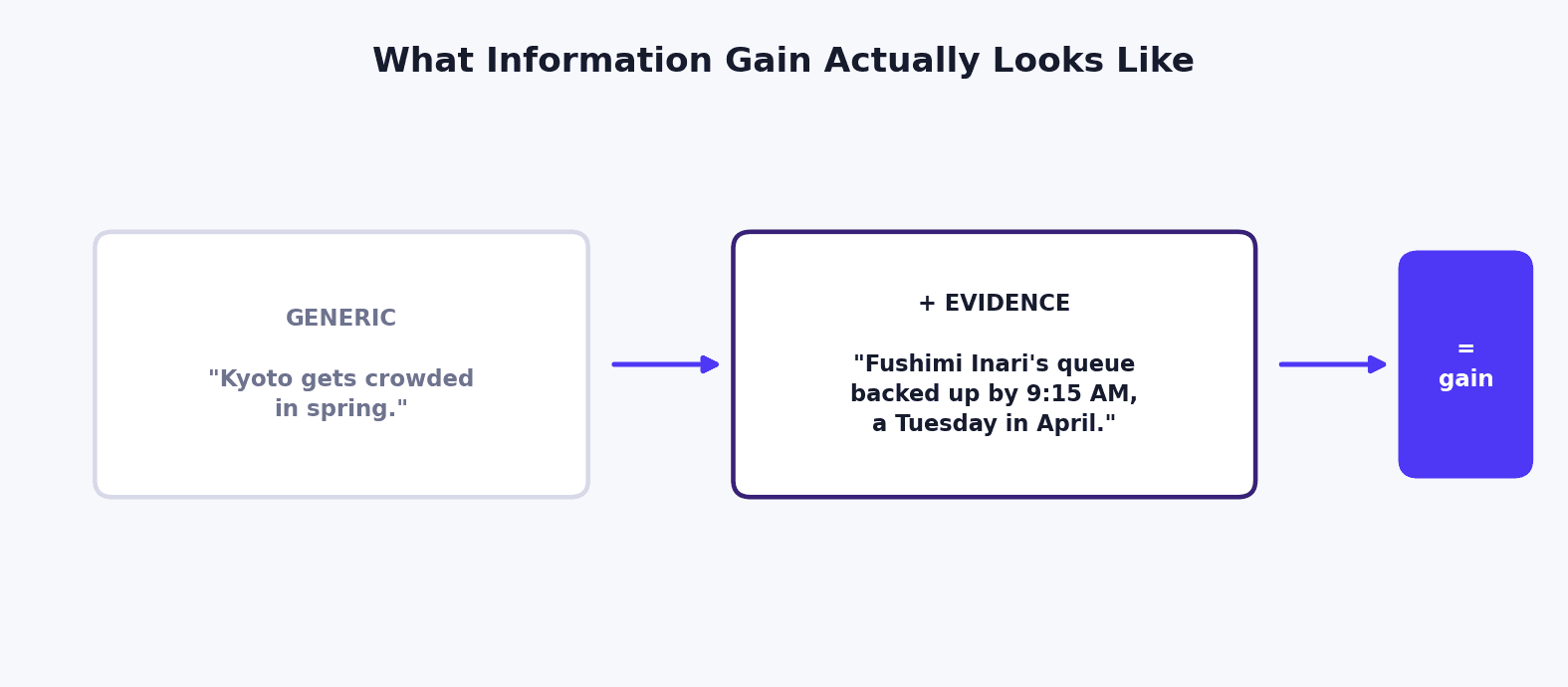
First-hand, specific observation. Not "Kyoto gets crowded in spring," which everyone already knows, but "the queue for Fushimi Inari's upper trail started backing up by 9:15 AM on a Tuesday in early April, well before the main gate crowds built up." Specific, checkable, genuinely new to someone who's only read the generic version.
Original data. Actual numbers from your own bookings, your own testing, your own audits, not a repeated industry statistic everyone else is also citing. I use this constantly in my own work, real booking patterns, real seasonal data, things a competitor simply doesn't have access to.
A specific, named expert's actual judgment. Not "experts recommend," which says nothing, but a real, credentialed person's actual, specific opinion, tied to their name and their background. That's the source-entity layer of E-E-A-T I've written about elsewhere on this blog, showing up here as an information gain lever too.
Direct comparison nobody else has bothered to make. Most competitor content covers each thing in isolation. A page that actually puts option A against option B on the same specific dimensions, cost, timing, accessibility, and states a real difference, adds something the isolated versions don't.
A Quick Scoring Habit I Use
When I'm reviewing a draft, I go through it and mark each paragraph with one of three labels: consensus (already stated everywhere), specific (a real detail, but one a determined competitor could also dig up), or exclusive (something genuinely only this source has, first-hand data, a named expert's direct input, a comparison nobody else made). A page that's entirely consensus paragraphs is the clearest sign the piece isn't ready yet. A healthy piece usually has at least a few exclusive paragraphs carrying real weight.
How I Actually Build This Into Content Now
Before writing anything, I read the top several ranking results for the topic and genuinely ask what they all already say. That list becomes the floor, not the target. Then I ask what I, or the business I'm working with, actually knows that isn't in that list. Real first-party data. A specific first-hand observation. A genuinely different comparison angle nobody else made.
If I can't find anything, that's a real signal, not something to write around. It usually means the piece needs a different angle entirely, or it needs an actual interview, a real data pull, or genuine first-hand testing before it's worth publishing at all. I've killed content briefs over exactly this, better to not publish than to publish the eleventh version of the same generic advice.
Here's roughly the sequence, laid out as steps:
1. Read the current top-ranking pages and list every fact they already share in common. 2. Treat that shared list as the floor every competing piece has already cleared. 3. Identify what's actually exclusive, first-hand data, a specific observation, a named expert, a real comparison. 4. If nothing exclusive exists yet, go get it, an interview, a data pull, direct testing, before drafting further. 5. Write the piece so the exclusive material carries real weight, not buried under restated consensus. 6. Review the draft paragraph by paragraph using the consensus/specific/exclusive labels above.
The Trap I Watch For
Information gain isn't the same thing as length or unusual claims. Padding a page with more words doesn't add information, it just adds words. And reaching for a contrarian claim purely to seem different is its own kind of dishonesty, one I actively avoid, because manufactured novelty isn't the same as genuine, evidence-backed novelty, and it tends to get caught eventually anyway, by a reader or by whatever's evaluating trustworthiness on the other end.
A Real Example of Killing a Brief
I mentioned earlier that I've killed content briefs over a lack of information gain, and I think the actual story is more useful than the general claim. A brief called for a page on "packing tips for a European cruise." I read through the existing top-ranking content, and every single piece said some version of the same five things, layers, comfortable shoes, a portable charger, a day bag, travel-size toiletries. Accurate. Also completely unremarkable, and already stated everywhere.
I asked around for anything genuinely exclusive we could add, real booking data on what guests actually forget most often, a specific expert's actual packing list, anything at all that wasn't already the industry-standard five points. Nothing came back. Rather than publish a sixth version of the same five points with different sentence structure, I shelved the brief until we had an actual interview lined up with a longtime cruise director willing to share specific, real observations. That delay cost a few weeks. The piece that eventually got published, built around that interview, actually said something the other ten results on the page didn't.
Why This Concept Made Me a Slower, More Deliberate Writer
Before I internalized information gain as a real filter, I could turn around a solid, accurate piece of content quickly, because "solid and accurate" was the whole bar. It's a higher bar now, and it's genuinely slowed down parts of my process, since finding or generating something exclusive takes real time that repeating the existing consensus never required. I've made peace with that trade-off, because the pieces that clear this higher bar consistently outperform the ones that don't, but it's worth being honest that this isn't a free upgrade, it costs more time upfront in exchange for content that's actually worth publishing.
Questions about information gain SEO
How is information gain different from just being accurate?
Accuracy means what you're saying is true. Information gain means what you're saying is also new relative to what's already covered elsewhere on the same topic. A page can be completely accurate and still add close to nothing if it's only repeating the existing consensus.
Where do I actually find something new to say if I've already researched the topic thoroughly?
Real, first-hand observation, original data you actually have access to, a specific named expert's direct opinion, or a genuine comparison angle other content hasn't made. If none of those are available, that's a real signal the content isn't ready yet.
Does information gain mean every page has to make a bold or unusual claim?
No, and I'd actively avoid that instinct. Manufactured novelty for its own sake isn't the same as genuine evidence-backed novelty, and it tends to undermine trust rather than build it.
Can a well-written, accurate page still fail on information gain?
Yes, and this is the trap I see most often. Good writing and accurate facts don't guarantee the content is adding anything a reader couldn't already get from the existing top-ranking pages on the same topic.
Is there a quick way to tell if a draft has enough information gain before publishing?
The paragraph-labeling habit I mentioned above works well as a fast check. Go through the draft and mark each paragraph as consensus, specific, or exclusive. If the whole piece is consensus, it's not ready. If there's at least a meaningful chunk of specific and exclusive material, it's usually in good shape.
Does information gain matter equally for every type of page, or mostly for blog content?
It matters most for informational and comparison content, where a reader genuinely has other sources to compare against. It matters less for something like a transactional booking page, where the job is closing a decision rather than adding new information to an existing body of knowledge. I still apply the same instinct there, but the bar looks a little different.
Is there a risk of over-relying on original data to the point of ignoring well-established facts?
Not really, since information gain builds on top of accuracy rather than replacing it. Well-established facts still need to be stated correctly, they're just not sufficient on their own anymore. The goal is accurate facts plus something genuinely additional, not novelty in place of accuracy.