I get some version of the same request constantly. "Can you add schema markup so we show up better for AI search." My answer is always the same, and it usually disappoints whoever asked it: schema is genuinely useful, and it will not fix vague content. I've watched teams treat JSON-LD like a patch you paste onto a page instead of what it actually is, a label describing content that has to already be doing the real work underneath.
What Schema Actually Does
Structured data is a declaration. It tells a machine, in a standardized format, what type of thing something is and what a few of its key properties are. TouristAttraction, Article, Person, Organization, each with defined fields the format expects. That's genuinely valuable, it removes ambiguity a machine would otherwise have to infer from unstructured text, and it can speed up how confidently a system verifies what your page is about.
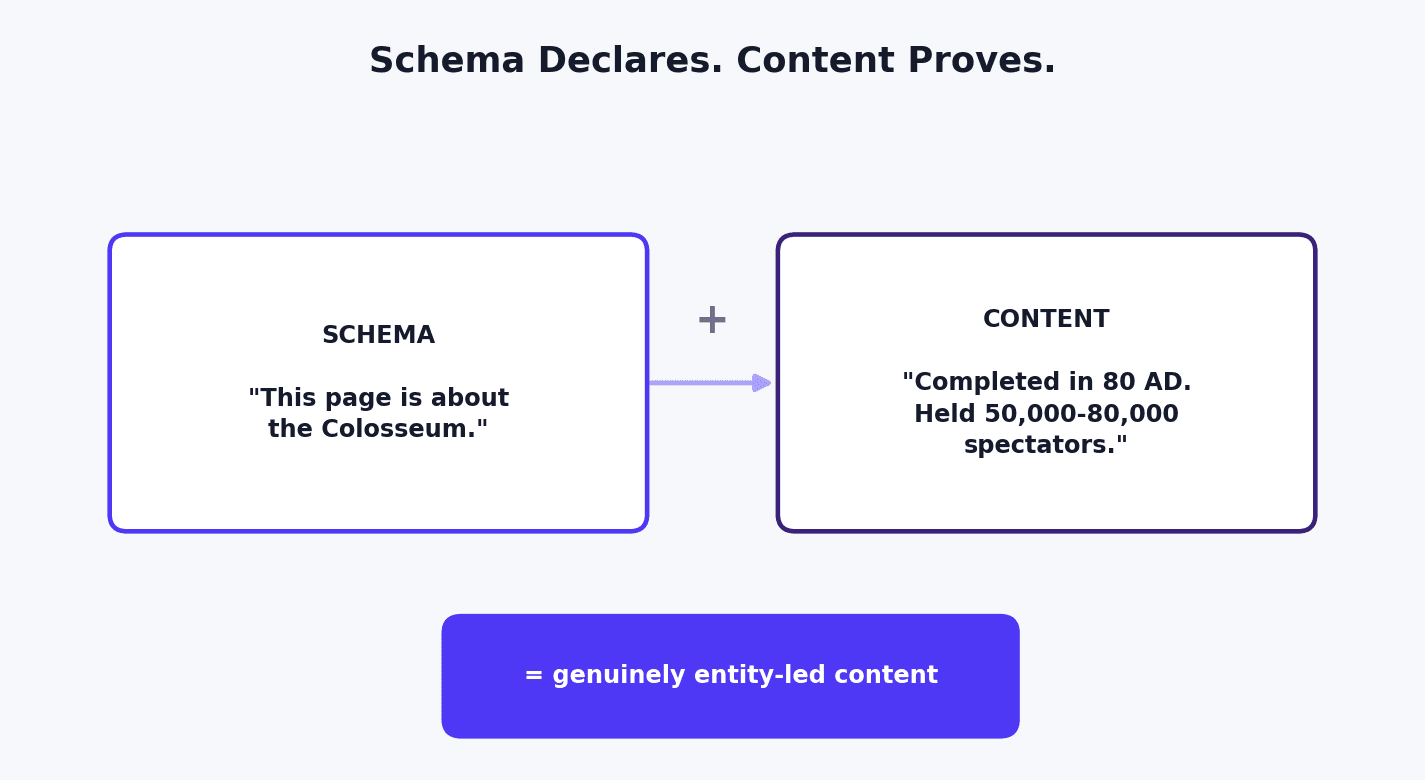
What it doesn't do is generate the substance being described. Schema can declare that a page is about the Colosseum. It cannot make the actual paragraph beneath that declaration specific, accurate, or useful. If the prose says "a famous and impressive ancient landmark," schema markup sitting on top of that sentence doesn't add the completed date, the capacity, or the location. It just labels a vague sentence as being vaguely about the right entity.
The Mistake I See Constantly
A team ships a page with thin, generic content, then adds a full JSON-LD block on top and treats the job as done. I've reviewed pages exactly like this: technically valid schema, about set correctly, sameAs linking out to the right Wikidata entry, and underneath all of that, three paragraphs of vague marketing copy that never states a single specific, checkable fact.
Here's the thing that makes this mistake so easy to make. The schema validates. Google's Rich Results Test shows a clean pass. Everything looks technically correct on the one dashboard people tend to check. And none of that tells you whether the actual content underneath is doing anything at all.
Why the Content Still Has to Carry the Weight
Schema and content aren't doing the same job, and they were never supposed to. Schema tells a machine what type of thing this is and confirms its identity against an external source. The actual prose is what has to state the specific, checkable facts, the attributes and values I've written a full post about elsewhere on this blog. One declares. The other proves. You genuinely need both, and I've come to believe the content side matters more, because a machine encountering thin content with perfect schema still has almost nothing extractable to actually cite.
Think about it from the retrieval system's side for a second. It's not just checking whether a page claims to be about the Colosseum. It's looking for a specific, well-formed, citable fact to pull into an answer. "The Colosseum, completed in 80 AD, could hold an estimated 50,000 to 80,000 spectators" is citable. Correct schema sitting above a paragraph that just says "a must-see historical site" gives it nothing to actually pull.
What Entity-Led Content Actually Requires
I think about it as three layers that all have to be present together:
| Layer | What it does | Who or what carries it | |---|---|---| | Clear identity | Tells a machine what and who the content is about | Schema, plus consistent naming | | Specific, stated facts | Gives a machine something real to extract | The actual writing | | External verification | Confirms the facts against independent sources | Wikidata, other trusted references, consistency across your own site |
Schema alone gets you the first layer and nothing else. I've watched teams max out effort on that one layer while leaving the other two completely untouched, and then get confused about why AI visibility didn't improve the way they expected.
A Quick Diagnostic Test
Before I even open a page's code to check the schema, I read the visible content and ask three questions in order:
1. Does the opening paragraph state a specific, checkable fact, a date, a number, a location, a credential, rather than a general claim? 2. Could a reader who's never heard of this entity walk away knowing something concrete, or would they just know the general category it belongs to? 3. If I deleted every adjective and kept only the nouns, verbs, and numbers, would there still be a real sentence left?
If the answer to any of those is no, the content needs work before the schema is worth spending more time on.
How I Actually Approach This Now
I always start with the content, not the schema. Does this page state specific, checkable facts about its subject, in plain, clear sentences, or does it just gesture vaguely at being about the right topic. If the content is vague, I fix that first, using the same rewrite pattern I use everywhere else, from "a beautiful, historic building" to "a 14th-century cathedral completed in 1345."
Only once the content itself is genuinely entity-led do I treat schema as the finishing step, the formal, machine-readable declaration confirming what the content already clearly says. Schema on top of strong content is genuinely powerful. Schema on top of vague content is decoration.
The Order I Actually Work In
For anyone wanting the concrete sequence rather than the philosophy:
1. Identify the true primary entity the page should be about. 2. Rewrite the opening section so it states specific, checkable facts about that entity, not generic praise. 3. Check every subsequent section for the same standard, one stated fact per claim, not a vague gesture. 4. Only then add or update the about, mentions, and sameAs schema to match what the content now actually says. 5. Validate the schema, but treat a clean validation as confirmation, not the goal itself.
A Pattern I Watch For When Reviewing Someone Else's Schema Work
When I inherit a site where someone else already implemented schema, I've learned to check one specific thing before assuming it's solid: whether the schema's declared facts actually match what the visible content says, word for word, not just in spirit. I've found pages where the schema states a founding date that doesn't appear anywhere in the visible text at all, effectively a fact that exists only in the markup and nowhere a human, or an extraction system reading the prose, would ever encounter it directly. That's a real missed opportunity, since the whole point of stating a fact is for it to actually be citable content, not just a hidden data point sitting in the page's source code.
The Reframe I Keep Coming Back To
If I had to compress this whole post into one line I actually say out loud in meetings, it's this: schema is a claim, content is the evidence for that claim. A legal filing that states a fact without any supporting evidence doesn't hold up, and neither does a page that declares an entity without actually proving anything specific about it in the writing itself. Keeping that relationship straight, claim versus evidence, has been the single clearest way I've found to explain this to people who've never thought about schema as anything other than a technical checkbox.
Questions about entity-led content schema
Does adding schema markup improve AI visibility on its own?
Not on its own, in my experience. It helps a machine confirm and verify what a page is about more quickly, but it can't manufacture specific, citable facts that the actual content doesn't already contain.
What should I fix first, my content or my schema?
Content first, always. Schema declares what a page is about and confirms its identity. If the underlying content is vague, accurate schema is just labeling a vague page correctly, which doesn't give a retrieval system anything more to actually cite.
How do I know if my content is genuinely entity-led or just technically tagged?
Read a section and ask whether it states a specific, checkable fact, a date, a location, a capacity, a credential, or whether it just gestures at a topic with generic, unverifiable praise. If it's the second one, the schema sitting on top of it isn't doing much.
Is it ever fine to add schema before the content is fully built out?
Sure, technically, schema can go on a page at any point. Just don't treat that as the finished job. The content still has to carry specific, stated facts for the schema to actually be pointing at something worth citing.
Can strong, entity-led content work well even with no schema at all?
To a degree, yes. Machines can still infer quite a lot from well-written, specific, unambiguous content alone. Schema speeds up and firms up that inference, and adds disambiguation content alone can't fully provide, but it's not the only path to being understood correctly. It's the more reliable path, not the only one.
What's a fast way to explain this distinction to a business owner or stakeholder who isn't technical?
I usually compare it to a passport versus a person. Schema is the passport, a formal, standardized declaration of identity. The content is the actual person the passport describes. A passport for someone who doesn't really exist, or whose stated details don't match reality, doesn't hold up under any real scrutiny, and neither does schema sitting on top of content that doesn't back up its claims.
How do I prioritize which pages get this treatment first if I have a large site?
I start with the pages carrying the most commercial or strategic weight, and separately, any page whose entity name is genuinely ambiguous, since that's where the gap between thin content and genuine entity-led content tends to cost the most.
How much time should I actually spend on schema relative to content?
In my experience, schema implementation for a given page usually takes a fraction of the time that fixing vague content does, once you have a template in place. That imbalance is itself a useful signal: if a team is spending more time debating schema properties than rewriting weak paragraphs, the effort is going to the wrong layer.