I've lost count of how many times a business has told me their content strategy is "we're building topical authority" when what they actually mean is "we're publishing a lot of stuff about roughly the same subject." Those are not the same thing, and I wish someone had drawn that line for me clearer, earlier in my career, because it would have saved a lot of wasted content budget.
The framework that finally gave me language for this comes largely from Koray Tuğberk Gübür's work, and the piece that mattered most to me is one word: connected. Topical authority isn't volume. It's a deliberately engineered network where every single piece relates back to one chosen subject in a way a search engine can actually verify, not just guess at from a topic tag.
Start With One Decision: Your Central Entity
Before a single page gets written, you need one specific decision made deliberately, the single subject every page on the site relates back to. Not "our niche," stated loosely. A specific, named entity, chosen up front, that every future topic gets checked against.
I've watched this exact gap sink content strategies more than any other single factor. Skip this step, and you end up with a huge content library and no consistent standard for whether any of it actually belongs together. I've inherited sites like this, hundreds of articles, technically all "related," with zero shared center anyone could point to.
Why You Deserve to Rank at All
There's a piece of this I think about constantly now, called Source Context. It's the honest answer to why your specific site deserves visibility for a topic, given your business model and audience, not just whether you can technically write about it. A recipe blog and a professional culinary school can cover the exact same dish, and their Source Context is completely different, which should visibly shape what each one actually publishes, not just how they market themselves.
The Filter Every New Topic Has to Pass
Central Search Intent ties your entity and your context together into one test every candidate topic gets measured against. Every time a new content idea comes up, I ask one question: does this genuinely serve what we're actually about, or is it topically adjacent but ultimately a distraction that dilutes focus instead of building it. I say no to a lot of technically-relevant ideas because of this filter, and it's made every content library I've worked on stronger, not weaker.
How I Prioritize What to Cover
Rather than chasing search volume first, this framework scores topics on three things, weighted deliberately:
1. How central the topic is to your core subject. This weighs heaviest, since it's what actually builds the coherent network. 2. How directly it serves your actual purpose. Not just relevance in the abstract, but whether it genuinely helps the specific audience this site exists for. 3. Search demand. Weighted lowest of the three, on purpose.
I used to lead with search volume in every content plan, because it felt like the safest, most defensible choice. I don't anymore. Deprioritizing raw demand lets genuinely important, lower-volume topics still earn a spot, because they strengthen the whole network even without independently pulling much traffic on their own.
The Idea That Actually Changed My Thinking Most
All of this adds up to what gets called a Semantic Content Network, not a pile of separately targeted keywords, but a genuinely organized network that costs a search engine less effort to retrieve, understand, and trust. That phrase, cost of retrieval, is the one that really stuck with me.
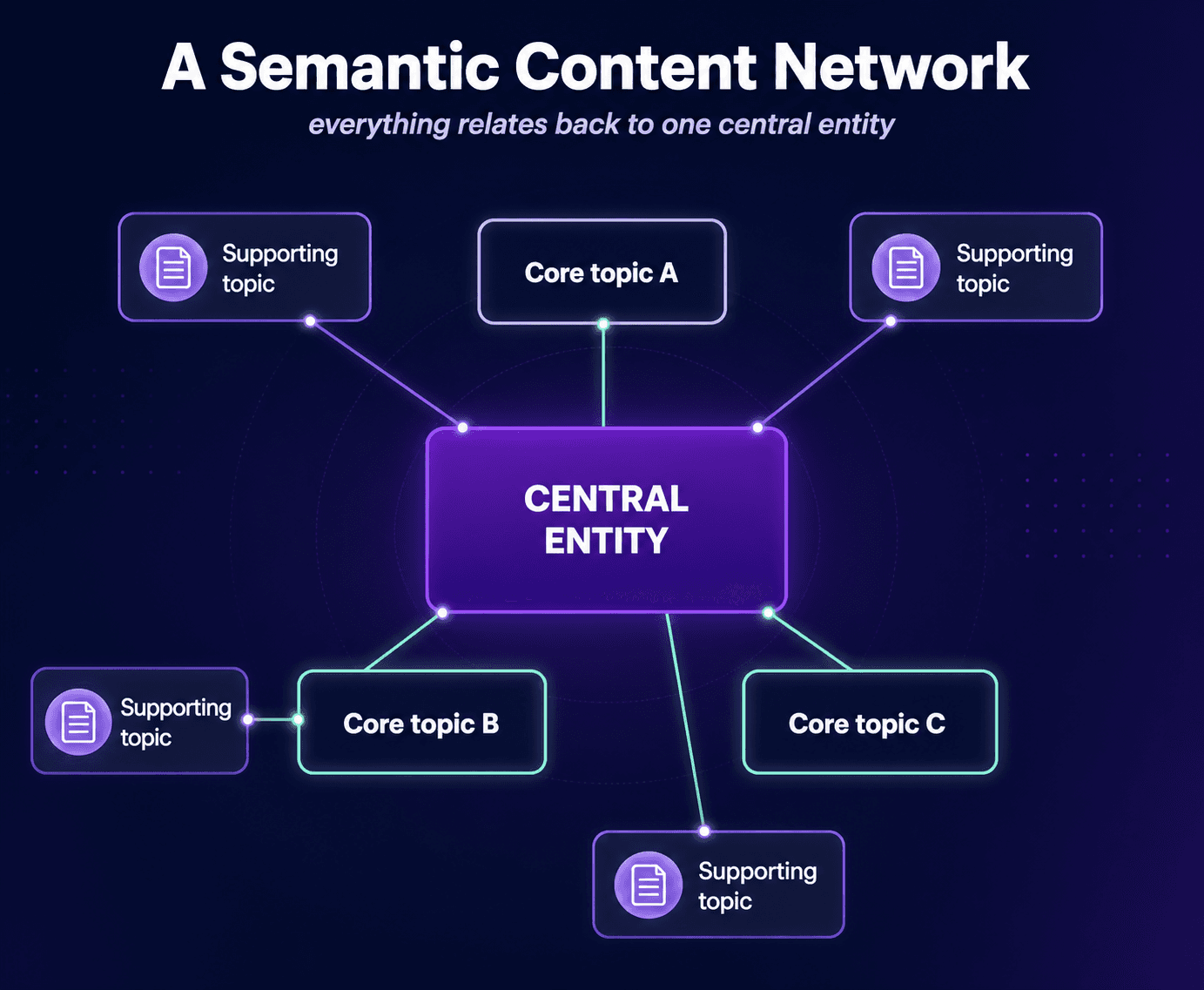
Everything routes back to that one center. Core topics sit closest, supporting topics sit one layer out and still link back in. Nothing floats off on its own.
Think about what a search engine has to do when it hits an unfamiliar, scattered site. It has to do real interpretive work to figure out what any given page is even about, whether it can trust it, how it fits with everything else. A genuinely coherent site skips a lot of that work, because the system already knows, from everything else on the site, what you're about and where your expertise actually sits. Lower cost of retrieval isn't a nice metaphor. It's a real reduction in the verification work a system has to do, and it translates directly into more confident rankings and citations.
Core Content and Supporting Content
I organize content into two layers now, for every business I work with. Core content covers the high-value subjects closest to the main entity. Supporting content builds authority around it and routes links back to the core, rather than existing as its own separate traffic play.
This matters more than it sounds. A supporting piece with no real internal linking connection back to the core is, from a search engine's perspective, basically an isolated page on an unrelated topic, no matter how related the subject matter looks to a human reader.
A Practical Way to Score Your Existing Content
If you're auditing a content library that already exists, here's roughly how I approach it. Pull a full list of published pages. For each one, score it on the same three dimensions the framework uses: how central is it to the actual entity, how directly does it serve the real audience, and separately, how much demand does it have. Then look specifically for pages that score low on centrality but high on demand, since those are usually the ones quietly pulling the site's overall coherence in a scattered direction, even while contributing traffic.
What I'd Actually Tell You to Do
Write down your Central Entity in one sentence, right now, before planning anything new. If you can't do it in one sentence, that's your actual problem, not your content calendar. Score new ideas against relevance to that entity before you even look at search volume. Build real, explicit internal links between every new page and your core content, not just loose topical adjacency. And check back periodically, because content libraries drift toward whatever's ranking well in isolation over time, and without checking against your original center, a genuinely coherent site can quietly erode into a scattered one.
A Real Example of Central Entity Drift
I inherited a travel content library once where the original Central Entity, as best I could reconstruct it, was something like "private, locally-guided travel experiences." Over several years, without anyone deciding to change direction, the content had drifted into covering general travel news, broad packing guides, and airline policy roundups, all technically travel-adjacent, none of it actually reinforcing the original core.
None of those individual pieces were badly written. The problem was structural: none of them routed back to the Central Entity in any real way, and the site had quietly become two different, competing identities without anyone choosing that outcome deliberately. Getting it back on track wasn't a content quality project. It was going through the whole library, scoring each piece against the original entity, and either strengthening the internal links back to the core or, in a fair number of cases, deciding a piece simply didn't belong on the site at all anymore.
Why I Now Revisit the Central Entity Statement Itself Periodically
I used to treat the Central Entity as a one-time decision, written once and never revisited. I don't anymore. Businesses genuinely evolve, and sometimes the Central Entity itself needs an honest update, not just a check on whether new content matches an old, outdated version of it. I now revisit the actual one-sentence statement itself every year or so, not just the content being measured against it, since an outdated center can quietly make otherwise-correct content decisions look wrong.
Why I Bring This Framework Up First With New Businesses
When I start with a new business now, this is usually the first real strategic conversation I have with them, before keyword research, before a content calendar. Getting the Central Entity and Source Context right up front shapes every decision that follows, and I've found it's much harder to retrofit this thinking onto an existing, sprawling content library than to build it in from the very first piece. It's a slower start. It pays off consistently enough that I no longer skip it, even when a business is eager to just start publishing.
Questions about topical authority
What's the actual difference between topical authority and just targeting a lot of keywords?
Keyword targeting optimizes individual pages for individual searches. Topical authority builds a genuinely connected network around one central subject, which reduces how much work a search engine has to do to trust and understand your site as a whole.
What is a Central Entity?
It's the single subject every page on your site relates back to, decided deliberately before you plan new content, and used as the standard every new topic idea gets checked against.
What does "cost of retrieval" actually mean?
It's how much interpretive work a search engine has to do to understand, verify, and trust your content. A genuinely organized site lowers that cost, because the system can lean on context it's already built up from your other pages.
Why would you weight search volume lowest when deciding what to cover?
Because leading with volume tends to produce a content library organized around what's popular rather than what actually, coherently serves your core subject. I've seen that trade-off go badly too many times to keep leading with volume.
How do I know if my existing content library already has this problem?
Pull a list of your published pages and try to state, honestly, how each one relates back to one central entity. Pages where that connection feels like a stretch, or where you can't articulate it at all, are the ones most likely dragging down your overall topical coherence.
Does topical authority mean I should never publish content outside my core subject?
Not never, but every expansion should be a deliberate decision, not an accident of chasing volume. Content genuinely outside your established center starts building trust from close to zero, so it's worth planning for that rather than expecting it to perform like your established core immediately.