For a long time I talked about E-E-A-T, Experience, Expertise, Authoritativeness, Trustworthiness, as if it were one fuzzy overall quality score sitting behind a page's ranking. I don't think that anymore, and honestly, that framing wastes a lot of time and budget. Google evaluates this at three separate levels at once, the individual page, the domain as a whole, and the specific person or company behind the content. Knowing which level is actually weak changes what you fix, and I've watched businesses pour money into the wrong one more times than I can count.
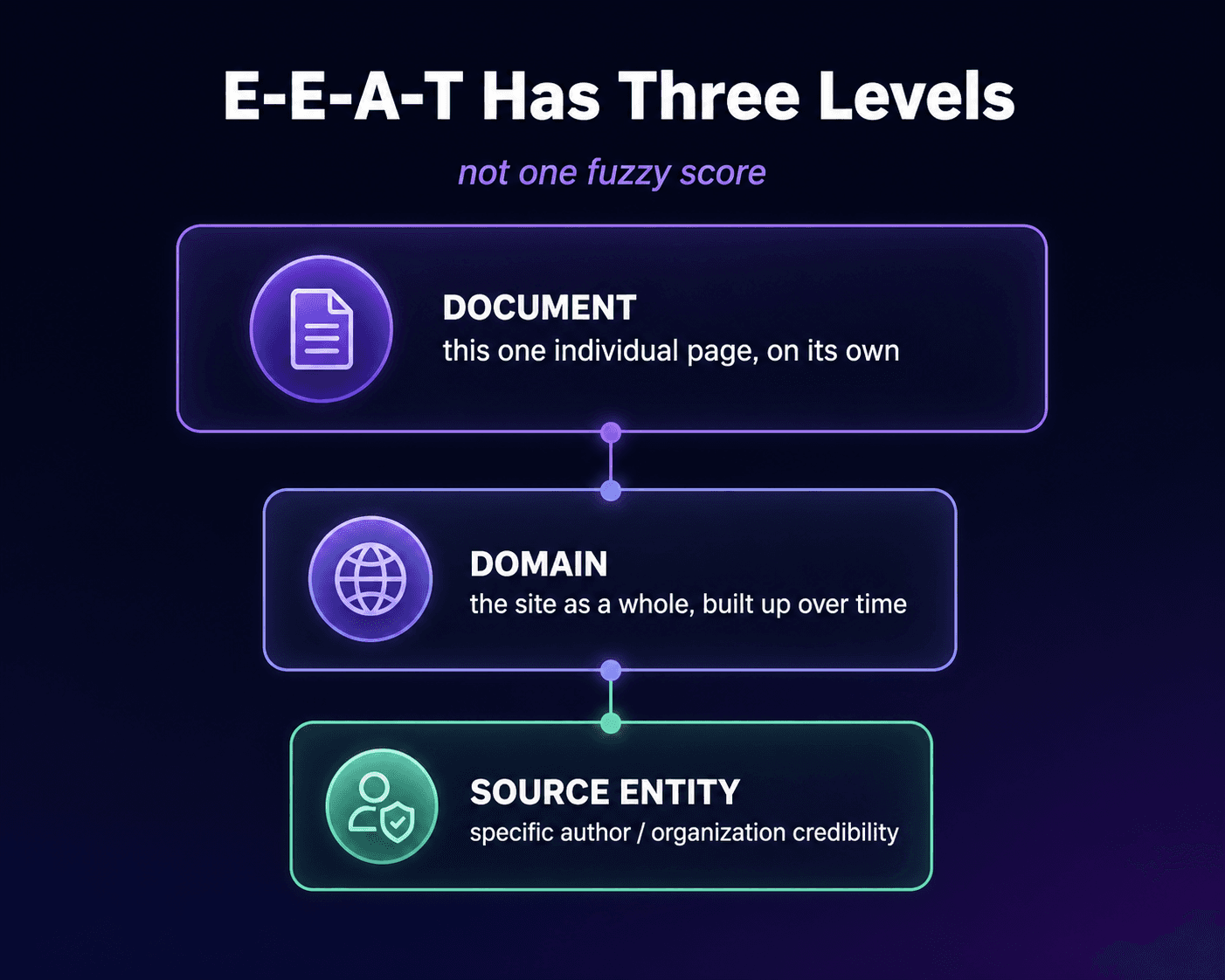
Each level widens the lens, one page, then the whole domain, then the actual person or organization behind it all. Weakness at any one of them drags the rest down with it.
Level One: The Document
This is about one page's own helpfulness and relevance, mostly independent of the rest of the site. A few specific things I check at this level:
- Does it say something genuinely useful you couldn't find just as easily elsewhere.
- Does it cover the topic from more than one angle, not just the one narrow phrase it was written to target.
- Is it actually kept fresh, or was it published once and forgotten.
- Does it link out to real, credible sources on its own topic.
- Is the writing and layout professional.
- Do people actually stick around and engage with it over time.
One signal I find genuinely useful and underused: the anchor text pointing to a page, both from other sites and internally, carries real weight here too. Contextually relevant anchor text can itself signal topic expertise, which is part of why I care so much about how internal links are worded, not just where they point.
Level Two: The Domain
This steps back from any single page to look at the site as a whole. The checks here are broader:
- Is the business's identity independently verifiable, not just self-declared.
- Is the link profile diverse and genuinely earned, not just large.
- Has the site ranked consistently for this topic over time, or is this new territory.
- Is the whole site's content actually focused, or scattered across a dozen unrelated subjects.
- Basic stuff like HTTPS still counts here too.
- Branded search volume, people literally searching for your company name, is a real signal, and it's hard to fake.
One I always check specifically: does the domain name actually match the business name. It sounds almost too simple, but mismatches here quietly work against you.
Level Three: The Source Entity
This is the one I think gets neglected the most, honestly, because it's the least visible in a typical SEO report and it takes real, specific work rather than technical fixes. It's about the individual author or organization actually responsible for the content:
- Do they have real, checkable credentials and a track record, not a generic "our expert team" byline.
- Do other credible sources actually reference them, not just self-references.
- Is their identity consistent everywhere they show up, same name, same stated background, not shifting from place to place.
- Does their actual background match the subject of this specific piece, not just their general reputation.
- Are they publishing regularly, since a single strong piece from an otherwise silent author carries less weight than a consistent track record.
Why I Stopped Treating This as One Score
Google's own guidance is pretty clear that trust is the most important piece of E-E-A-T, because content that isn't trustworthy has low E-E-A-T no matter how experienced or expert it otherwise looks. Once I understood the three-level structure, I finally understood why that's true mechanically. Trust signals show up at all three levels at once, verified business info at the domain level, real credentials at the source-entity level, credible outbound links at the document level. A serious trust problem at any one of them drags the whole evaluation down, no matter how strong the other two are.
This matters even more now with AI search, honestly. A document-level weakness, thin, generic content, used to be somewhat maskable by strong overall domain authority in classic rankings. In AI retrieval, where individual passages get evaluated and cited far more granularly, weak spots at the document and source-entity levels have a lot fewer places left to hide.
How I Actually Audit This Now
For the document: does this specific page say something with real, unique value. Is it current. Does it link out to credible sources.
For the domain: does the site as a whole show consistent, original coverage of this subject, or is this one page an outlier surrounded by unrelated content. Is the business independently verifiable.
For the source entity: is there a named, credentialed author whose actual background matches this specific topic, and is their identity consistent everywhere else they appear.
A page can score fine at one level and genuinely weak at another. I've seen businesses spend months polishing individual pages, the document level, while the actual problem was that nobody credible was named as the author, the source-entity level, and no amount of page-level polish was ever going to fix that.
A Simple Way to Diagnose Which Level Is Actually Weak
When something isn't performing the way it should, I now work through the three levels in order, rather than jumping straight to a page rewrite:
1. Read the specific underperforming page on its own merits. Does it genuinely say something useful, current, and well-supported? 2. Zoom out to the whole domain. Does it show a coherent, focused pattern of expertise, or does this page sit in relative isolation surrounded by unrelated content? 3. Look at the actual author or organization behind it. Is there a real, checkable, topic-matched credential attached, and is it consistent everywhere else that person or organization shows up?
Whichever level comes back weakest is where I focus first, since fixing a strong level further tends to produce much smaller gains than fixing the genuinely weak one.
A Real Example of Diagnosing the Wrong Level
I want to walk through an actual pattern I've hit more than once, because I think it illustrates the framework better than another abstract description would. A business comes to me convinced their content simply "isn't good enough," and asks for a full rewrite of their top pages. I read the pages. They're genuinely fine, clear, specific, reasonably well-structured. Document level: solid.
I check the domain. The site covers their core subject consistently, no scattered, unrelated content diluting focus. Domain level: also solid.
Then I check the source entity. Every article is published under a generic "Staff Writer" byline, no name, no credentials, no consistent identity anywhere else online. Source-entity level: genuinely weak, and it's the actual bottleneck, not the writing quality the business assumed was the problem.
The fix in that case wasn't a content rewrite at all. It was attaching real names and real, topic-matched credentials to the existing content, and making sure those names showed up consistently elsewhere too. Rewriting the pages themselves would have spent real budget improving a level that was never actually the weak one.
Why I Now Ask "Which Level" Before "What's Wrong"
That pattern repeats often enough that it's changed my first question on any underperformance conversation. Instead of jumping straight to "what's wrong with the content," I ask which of the three levels is actually weak first, because the fix looks completely different depending on the answer, and a rewrite aimed at the wrong level burns time and budget without addressing the real bottleneck at all.
Why I Bring Up the Anchor Text Detail Specifically
I mentioned anchor text as a document-level signal earlier, and I want to come back to it because it's one people consistently overlook. It's easy to focus entirely on the words inside a page's own body copy and forget that how other pages, including your own internal pages, describe and link to it is itself a signal about that page's actual subject and credibility. I now review internal anchor text with almost the same scrutiny I give body copy, since vague anchor text like "click here" or "learn more" is a genuinely wasted opportunity to reinforce exactly the kind of topical, credibility-relevant signal this level of the framework is measuring.
Questions about E-E-A-T levels
What are the three levels of E-E-A-T?
The document (an individual page's own quality), the domain (the site's overall authority and consistency), and the source entity (the credibility of the specific author or organization behind the content).
Which level matters most?
Trust is described as the most important overall piece, and it shows up at all three levels at once. A serious trust problem at any single level can drag the whole thing down, even if the other two are strong.
Can a strong domain make up for one weak page?
Somewhat, in classic rankings. Less reliably in AI search, where individual passages get judged and cited much more granularly, leaving weak spots at the page and author level with fewer places to hide.
Which level do most companies neglect?
In my experience, the source entity level, by far. It needs specific, real, consistently presented credentials, not just technical fixes, and it's the one most reporting dashboards don't even measure.
How do I know which of the three levels is actually causing a ranking or visibility problem?
Work through them in order, page quality, domain coherence, then author credibility. Whichever one is genuinely weakest is usually where the actual problem lives, even if it's not the level that feels most obvious to fix first.
Is it possible to fix the source entity level without hiring a well-known expert?
Yes, in my experience. What matters is a real, checkable, topic-matched background and consistent identity across sources, not celebrity status. A genuinely credentialed but not famous author, presented consistently, can meaningfully strengthen this level.
How often should a business re-run this three-level audit?
I'd suggest at least once a year for an established site, and sooner after any major change, a rebrand, a new content direction, a shift in who's actually writing the content, since any of those can quietly weaken a level that used to be strong.