Two ideas I've come across, from two completely different corners of SEO research, keep landing on the exact same unit of meaning. One is about what NLP systems actually need from a sentence: clear semantic triples, subject, predicate, object, and an attribute when it's useful. The other is about what actually organizes meaning in the first place, and argues the verb, the predicate, is the real anchor.
Put those together and you get something I use constantly now: the semantic triple, subject then predicate then object, is the smallest unit of meaning both Google's systems and AI retrieval actually extract and work with. Not the paragraph. Not the page. The triple. Everything else on a page is either a well-formed triple, a bunch of them, or noise that makes triples harder to find.
What a Triple Actually Looks Like
Three parts. The subject, the main entity a sentence is about. The predicate, the relationship or action connecting subject to object, almost always the verb doing the work. The object, whatever the subject relates to. "The Louvre houses the Mona Lisa" is a complete triple, done in five words.
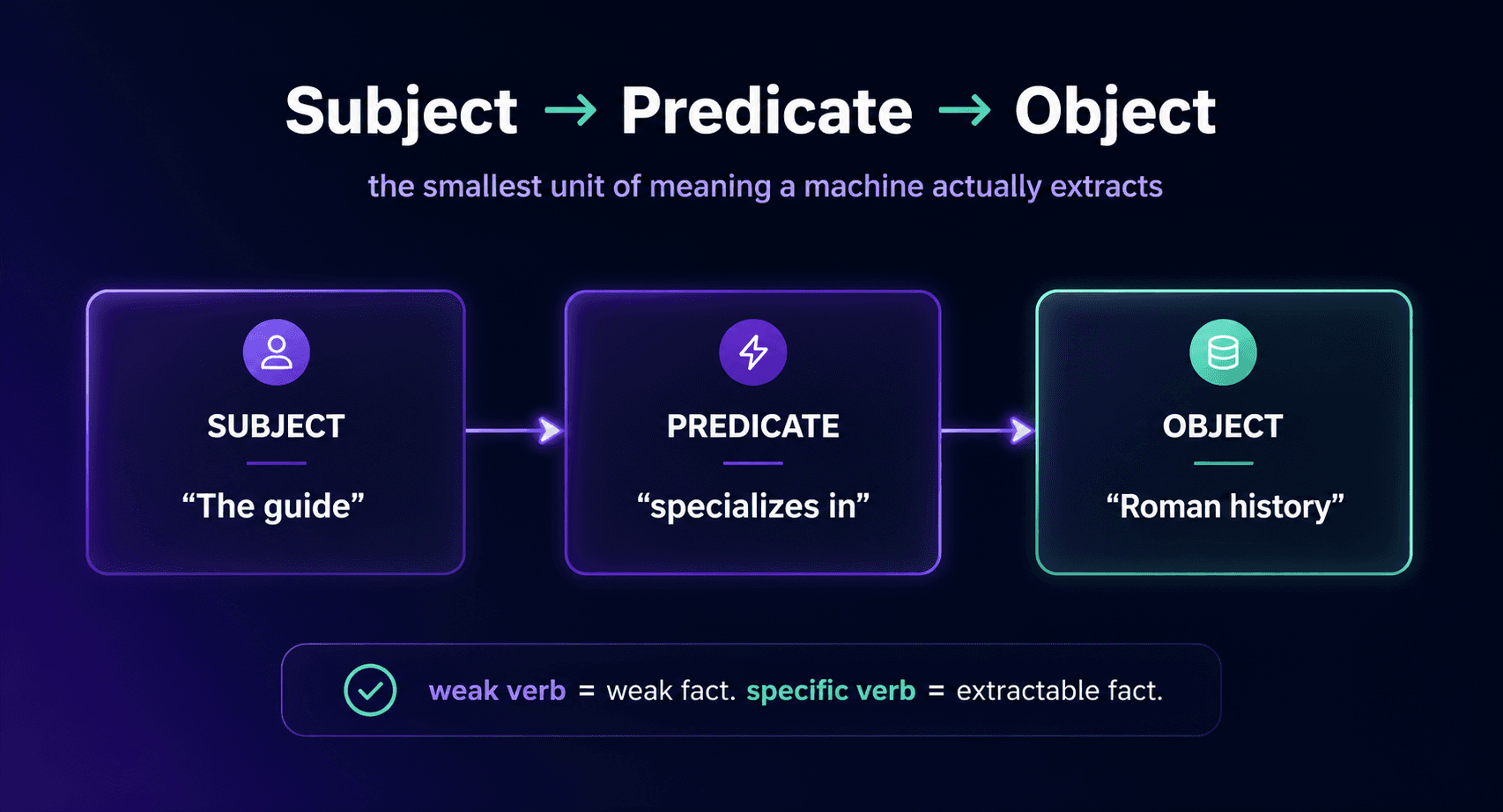
Three boxes, one arrow between each. That's genuinely the whole unit. Weak verb in the middle box, weak fact, no matter how strong the subject and object are.
A sentence that doesn't map onto this cleanly isn't extractable as a fact, no matter how well-written it otherwise is. "There's a lot to see at the Louvre" has a subject, sure, but no real predicate-object pair making an actual, specific claim. Reads fine to a person. Hands a machine nothing to work with.
The Part I See Go Wrong Constantly: The Verb
Subjects are usually easy, most writers know what a sentence is about. Objects are usually fine too. The predicate, the verb, is where I see quality break down most, because a weak verb produces a weak, low-information triple even when the subject and object are both perfectly specific.
Compare "the guide has knowledge of Roman history" with "the guide specializes in Roman history." Same subject, roughly the same object. Completely different predicates. "Has knowledge of" is vague enough to describe almost any level of familiarity. "Specializes in" makes a specific, much more useful claim about the actual relationship.
This connects to something I mentioned in an earlier post, that verbs act as anchors for meaning, pulling in a whole neighborhood of related expectations depending on which one you pick. "Increase" pulls in a completely different set of related concepts than "freeze" does, even attached to similar subjects. Choosing a precise verb isn't a style preference in my mind anymore. It's choosing which entire semantic neighborhood your sentence's claim gets filed under.
The Patterns I Flag Every Time I'm Editing
Turning a verb into a noun. "The guide provides an explanation of Roman history" instead of "the guide explains Roman history." The real meaning gets buried inside a noun, "explanation," behind a weaker verb, "provides," and that's genuinely harder for a parser to pull out as the main relationship.
Passive voice putting distance between subject and predicate. "Roman history is covered extensively by the guide" delays the exact order an extraction system is built to expect, compared to "the guide covers Roman history extensively."
Hedged predicates. "The guide might be able to help with questions about Roman history" buries a weak, conditional verb where a direct one belongs. If the guide genuinely does answer those questions, just say "the guide answers questions about Roman history." More accurate and dramatically more extractable, at the same time.
Sentences smuggling in a second claim. "The guide, who has led tours since 2012 and specializes in Roman history, will meet you at the entrance" is at least three separate triples stacked into one sentence, and, based on the citation research I've written about elsewhere on this blog, that measurably hurts how reliably any of them get extracted.
A Rewrite I'd Actually Do
Before: "There's a good amount of interesting stuff to learn about the Colosseum, which was built a long time ago and is definitely worth checking out with a knowledgeable guide who can really bring the history to life." No clean triple in there at all. Vague predicates, unstated objects, buried subject.
After, as three separate triples: "The Colosseum was completed in 80 AD. It could hold an estimated 50,000 to 80,000 spectators. A licensed guide explains the amphitheatre's construction techniques and its role in Roman public life." Three sentences, three clean, independently extractable facts, none of them needing the reader, or the machine, to do interpretive work the original sentence left undone.
Attributes: The Optional Fourth Piece
Sometimes a triple benefits from a fourth element, an attribute modifying the object or the relationship itself. "The Colosseum was completed in 80 AD" is a clean triple on its own. Adding "under Emperor Titus" attaches an attribute that enriches the fact without breaking its single-claim structure, since it's modifying the existing relationship rather than introducing an entirely separate claim. The test I use: does the addition describe the existing triple more precisely, or does it sneak in a second, independent fact? The first is fine. The second belongs in its own sentence.
The Checklist I Actually Run
I go through each sentence and ask:
1. What's the subject, and if it's a pronoun, is it close enough to what it's replacing to resolve cleanly? 2. What's the predicate, and if it's a weak, generic verb like has, is, provides, involves, is there a more specific one available? 3. What's the object, and if it's vague, "a lot of history," "great things to see," what's the actual fact I mean? 4. Does the sentence contain more than one subject-predicate-object combination? If so, I split it, one triple per sentence. 5. Is there an attribute genuinely modifying the existing triple, or is it a second claim disguised as a detail?
Triples and the Rest of This Blog's Framework, Tied Together
I think the triple is genuinely the connective tissue between most of what I've written about elsewhere on this blog, even though it doesn't always get named directly. Named entity recognition is what identifies the subject and object in the first place. Part-of-speech tagging is what happens before any of it, sorting out which word is even doing the verb's job. The Entity-Attribute-Value model is close to a synonym for the same underlying idea, entity, attribute, value mapping almost directly onto subject, predicate, object. And entity schema's about property is, in a real sense, a machine-readable declaration of a triple's subject, stated outside the prose itself for extra certainty.
Once I saw how many of these separate concepts all resolve to the same small structure, auditing content got a lot simpler. I stopped running five separate mental checklists and started running one: is there a clean subject, a specific predicate, and a clear object in this sentence, and if not, which piece is missing.
A Word of Caution Against Overcorrecting
I've seen people take this framework and swing too far, chopping every sentence into a rigid subject-verb-object structure until the writing reads like a technical manual. That's not the goal, and it usually reads worse to an actual person without meaningfully improving extractability further, since the gain from clean triples mostly comes from fixing the genuinely weak, vague sentences, not from flattening every sentence that was already fine. I check for weak triples specifically around the facts I most want extracted, not as a rule applied uniformly to every single sentence on a page regardless of how well it was already working.
Questions about semantic triple SEO
What's a semantic triple, in plain terms?
The subject-predicate-object structure that NLP systems and AI tools use to pull discrete facts out of text. A subject entity, a predicate describing the relationship or action, and an object. It's the smallest unit of meaning these systems reliably work with.
Why does the verb matter more than most people assume?
The verb carries the predicate, the actual relationship between subject and object. A weak verb produces a weak triple even with a specific subject and object, and different verbs place your claim into entirely different, related territory in a machine's mind.
Does writing in triples mean I can't write complex sentences anymore?
Not entirely, but any sentence carrying more than one distinct subject-predicate-object claim is functionally several triples stacked together, and that's harder to extract reliably. Splitting those into separate sentences usually improves extractability without hurting readability at all.
How is this different from the earlier post on NLP for SEO?
That post covers the broader parsing process, tokenizing, entity recognition, dependency parsing. This one zooms into the specific output of that process, the triple itself, and the verb as the piece most commonly weak.
Can a single sentence contain more than one valid, clean triple?
Technically yes if they're extremely tightly connected, but in practice I still tend to split them, since research on how AI citation actually works has consistently shown single-claim sentences get extracted more reliably than compound ones, even when each individual claim is clean.
Is it worth going back and auditing old content for weak triples?
In my experience, yes, especially for pages that matter competitively. It's usually a faster fix than a full rewrite, since the structure and research are often already sound, and swapping weak verbs for specific ones is a relatively quick, high-leverage edit.
What's the fastest way to spot a weak triple while skimming a page?
Look for sentences leaning on "is," "has," "provides," or "involves" as the main verb. Those four show up constantly in weak triples, and swapping any of them for a more specific verb is usually the single fastest improvement available on a given page.
Do triples need to always follow subject-verb-object word order exactly?
No, the underlying structure matters more than the literal word order, which varies across languages and even across valid English sentence constructions. What matters is that the three roles, who or what, the relationship, and what it relates to, are all clearly identifiable, however the sentence is actually built.
Can a triple have more than one object?
Occasionally, when a single verb genuinely connects to two related objects, "the guide covers Roman history and early Christian sites" is still reasonably clean. I'd still watch for that pattern drifting into a second, unrelated claim disguised as a second object, which is the same trap I described earlier with attributes.