Somewhere in the last couple of years, our industry decided it needed a new name for itself about every six months. SEO wasn't enough anymore. Then it was AI SEO. Then GEO. Then AEO. Then LLMO. I've seen someone earnestly pitch "AIO" in a deck. I sat through that entire meeting and, ten years into this job, genuinely couldn't tell you what problem the new name was solving that the old one wasn't.
I want to be clear about what I'm not saying. I'm not saying nothing has changed. Retrieval is genuinely different now, chunking is real, citation isn't the same mechanic as ranking. What I am saying is that the naming fight is mostly a distraction from the part of the job that actually moved, and I've watched it eat meeting time that should have gone to fixing actual pages.
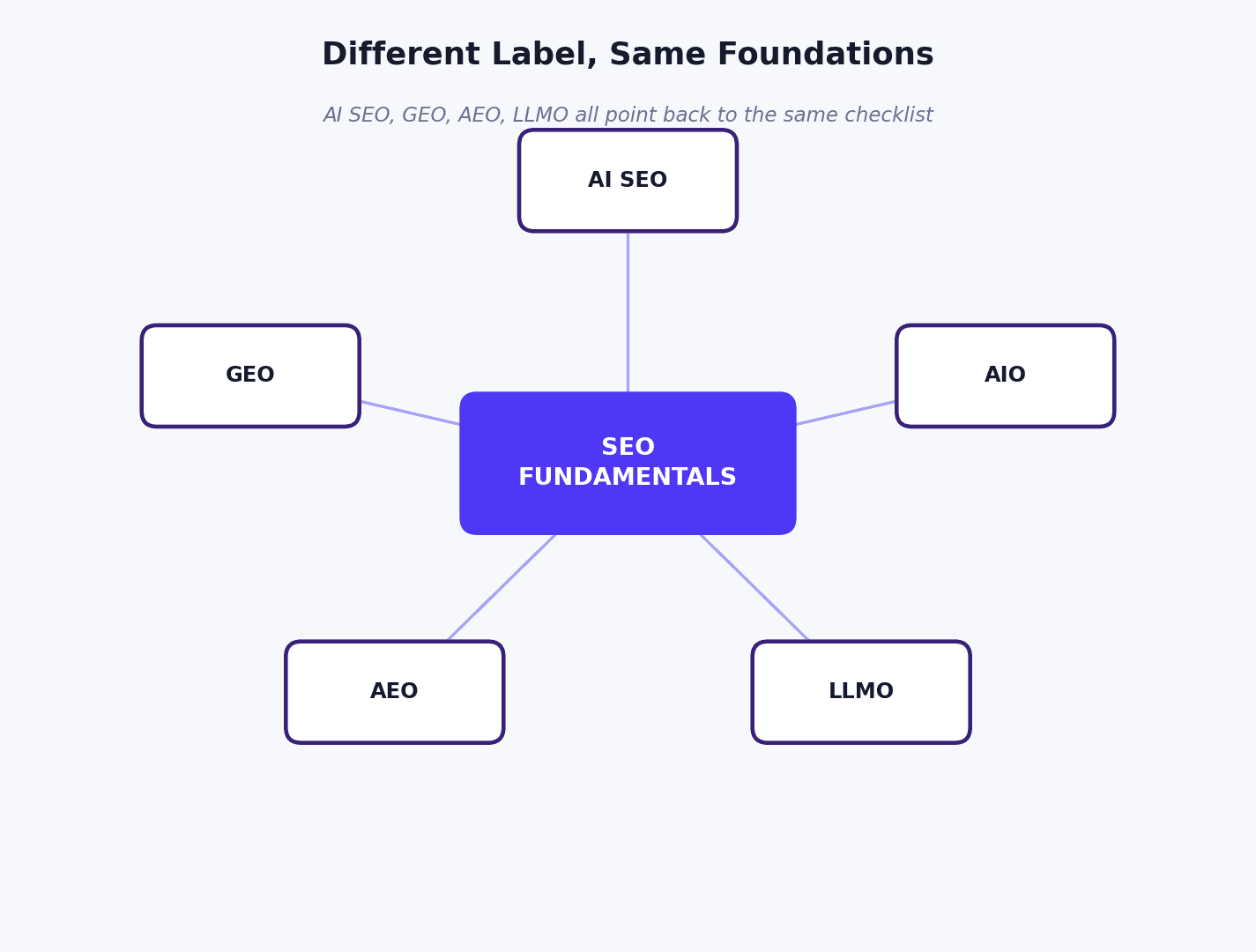
The List, So Far
SEO. AI SEO. GEO, Generative Engine Optimization. AEO, Answer Engine Optimization. LLMO, Large Language Model Optimization. AIO. I've genuinely lost track of whether there's a new one since I started drafting this post. Every one of them gets pitched with the same energy: this is a fundamentally new discipline, the old rules don't apply anymore, you need a specialist for this now.
I get why the pitch works. "New discipline" sounds more billable than "same discipline, some new mechanics." I'm not accusing anyone of bad faith here, plenty of people pushing these labels genuinely believe in them. I just don't think the underlying work supports treating them as separate jobs.
A Quick Glossary, Since the Acronyms Keep Multiplying
| Term | What it's supposed to mean | What it actually is | |---|---|---| | AI SEO | Optimizing for AI-powered search features | SEO, applied to a newer surface | | GEO | Generative Engine Optimization | SEO, aimed at generative answers instead of blue links | | AEO | Answer Engine Optimization | SEO, aimed at direct-answer boxes and voice results | | LLMO | Large Language Model Optimization | SEO, aimed at chatbot citation specifically | | AIO | "AI Optimization" | A newer label for the same combined goal all the others describe |
I made this table half as a joke and half because I think seeing them lined up side by side makes the pattern obvious faster than any paragraph could.
What's Actually New, Genuinely
I don't want to pretend nothing changed, because that's its own kind of dishonesty. Retrieval systems break a query into sub-queries and search several angles at once, which I've written about elsewhere on this blog as query fan-out, and that's a real mechanical difference from how classic ranking works. Content gets evaluated and cited in chunks, individual passages, not whole pages, which changes how you should structure a page even if it doesn't change what makes a good sentence. And the output is a citation embedded in a generated answer instead of a blue link in a list, which changes what "winning" even looks like on the page.
Those are real, specific, mechanical changes. I'm not dismissing them. I've adjusted how I brief content because of every one of them.
What Isn't New At All
Here's the part that gets buried under all the renaming. Entities still need to be clearly stated, not vaguely gestured at, the exact thing I've written a whole post on this blog about with the Entity-Attribute-Value model. Trust still gets evaluated at multiple levels, the page, the site, the actual person behind it, which is precisely the three-tier E-E-A-T structure I've also covered here. Clear sentences with one stated fact still beat vague, hedgy paragraphs, whether a classic crawler is parsing them or a retrieval system is chunking them for citation. Structure still helps, headings, lists, self-contained sections, for exactly the same underlying reason it always did: it reduces the work required to figure out what a piece of content is actually saying.
None of that changed when the acronym changed. I'd argue none of it can change, because it's not really about any specific system. It's about making meaning as unambiguous as possible for anything trying to parse it, human or machine, and that requirement predates every one of these acronyms and will outlast whatever gets pitched after them too.
Why I Actually Stopped Caring About the Label
I used to get genuinely worked up about this, correcting people mid-meeting, insisting on precise terminology. I don't anymore, and here's the honest reason why: the naming argument doesn't change a single line of the audit. Whether I call it AI SEO or GEO or just SEO, the actual checklist is identical.
- Is the entity stated clearly?
- Is the page structured so a passage can stand alone?
- Is there a real, checkable fact where there used to be a vague claim?
- Does the domain and the author behind this content have real, verifiable credibility?
I've sat in exactly one too many meetings where forty-five minutes went to debating whether we should call the service line "AI SEO" or "GEO" on a proposal, and zero minutes went to the actual page in question, which had a vague, unstructured "About Us" section that hadn't been touched since 2019. That's backwards, and it happens more than I'd like to admit across this industry right now.
What I Actually Focus On Now
I use whatever term the person in front of me already understands, and I don't correct them mid-conversation for using "SEO" when someone else on their team would call it "GEO." If a business I'm working with says "we need AI SEO," I hear "we need our content to show up and get cited in AI-generated answers," and then I go do the same fundamentals-first work I'd have done under any other label.
In practice, that means starting every engagement the same way, regardless of which acronym got us in the room:
1. Audit whether entities are stated clearly and disambiguated. 2. Check whether content is structured for passage-level retrieval, not just page-level readability. 3. Verify trust signals exist at the page, domain, and author level. 4. Only then, layer in whatever surface-specific tactics actually matter, schema, sitemap hygiene, chunk formatting.
The order matters. Skipping straight to step four without the fundamentals underneath it is exactly how you end up with technically correct markup sitting on top of a page that still doesn't say anything specific.
The Foundations Really Are the Same
Clear entities. Stated facts, not vague gestures. Structure that lets a section stand on its own. Trust signals at every level, not just the page. That checklist doesn't care what you call the discipline, and after ten years of watching terminology come and go, I trust the checklist a lot more than I trust whatever name is currently trending.
What I'd Actually Rename, If I Could Rename Anything
If I had to pick one thing in this whole debate actually worth renaming, it wouldn't be the discipline itself. It would be the job title. "SEO specialist" undersells what the work now actually requires, structuring for chunk-level retrieval, understanding multi-source trust evaluation, thinking about citation instead of just ranking position. But undersold job titles are a much smaller problem than a fractured, confused market chasing five different acronyms for the same underlying skill set, and I'd rather see the energy currently spent on naming debates redirected toward actually teaching that expanded skill set clearly, under whatever banner people are comfortable using.
One Last Thing Worth Saying Plainly
I don't think this naming debate is going away anytime soon, and honestly, a new acronym might show up between me writing this and you reading it. That's fine. My actual advice doesn't depend on predicting the next label. It depends on the same checklist holding steady underneath whatever gets pitched next, and after watching that checklist survive every rename so far, I'm comfortable betting it survives the next one too.
Questions about AI SEO vs GEO
Is GEO actually a different discipline from SEO?
In my experience, no, not in any way that changes the day-to-day work. What changed is retrieval mechanics, chunking, and how citations get generated, all real, but the underlying fundamentals of clear entities, structure, and trust are exactly the same discipline they've always been.
Should I stop using terms like "AI SEO" or "GEO" entirely?
Not necessarily. Use whatever term the people you work with already understand. I don't think the label matters nearly as much as whether the actual content work gets done.
What genuinely is different about optimizing for AI search versus classic search?
Query fan-out, meaning one query becomes several sub-queries searched in parallel, and chunk-level retrieval, meaning individual passages get evaluated and cited rather than whole pages. Those are real mechanical differences worth adjusting your structure for.
Why do you think so many new terms keep getting coined?
Some of it's genuine attempts to name real mechanical shifts. Some of it, honestly, is that "new discipline" sounds more sellable than "same discipline, a few new mechanics to account for." I try to stay focused on the actual checklist either way.
If someone insists on hiring a specialist for "GEO" specifically, is that a red flag?
Not automatically, but I'd ask them what specifically they think is different about the work, and listen for whether the answer is genuine mechanics, like chunk-level structure, or just repackaged fundamentals with a new label attached. Both can be delivered well; only one justifies treating it as an entirely separate discipline.
Does this naming debate matter at all, or is it completely irrelevant?
It matters a little, mostly for internal communication, so a team agrees on shared vocabulary. It stops mattering the moment it starts eating time that should go to the actual audit and the actual page. That's the balance I try to strike.
How do you respond when a business specifically asks for a "GEO strategy" as if it's a distinct deliverable?
I give them one, using whatever label they want on the proposal, built from the same fundamentals-first checklist I'd use under any other name. The deliverable matters more than the title on the cover page, and I've learned it's rarely worth the friction of correcting someone's terminology mid-project.